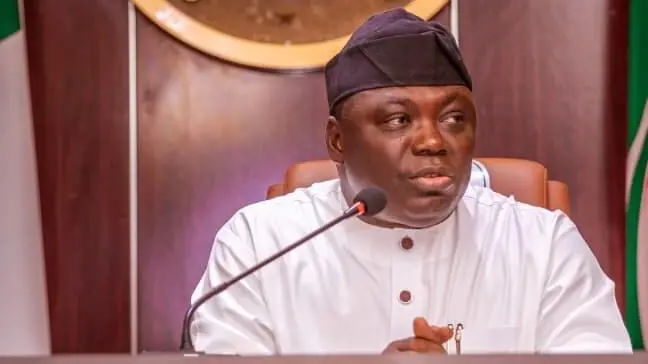
A former President of the Nigerian Bar Association (NBA), Olumide Akpata, says it is only by sheer luck that the Nigerian judiciary can produce a good judge.

Akpata stated this recently at the International Bar Association (IBA) conference in Paris, France. Addressing the gathering, the former NBA president noted that Nigeria remains the largest black nation on earth, adding that the country is confronted with a major problem he termed, “judiciary capture.”
Similarly, a law professor and former chairman of the National Human Rights Commission (NHRC), Chidi Odinkalu, shared Akpata’s perspectives on his X (formerly Twitter) handle on Friday.
In two short videos he posted, Akpata, who was the NBA president between 2021 and 2022, and is now vying for the Edo State governorship election next year, was seen lamenting how Nigeria’s political class had emasculated the judicial system.
Drawing on his experience as president of the NBA, Akpata recalled how flawed the recruitment process of judges is in the country, saying: “For a good judge to emerge out of that process is by fluke only; sheer luck with judicial appointment in Nigeria; It is ridiculous”.
He also accused some judges of living above their legitimate income by sending their children to Ivy League schools abroad, such as Cambridge, Yale and Harvard.
Being president of the NBA conferred Akpata with the statutory membership of the National Judicial Council (NJC), a body saddled with the responsibilities of recruiting and disciplining erring judges in Nigeria.
Without giving further details of his observations while being on the recruitment panel for judges, Akpata described his findings as “bizarre”.
Recently, Odinkalu, a vocal critic of the process of appointment of judges, wondered why heads of courts like the Chief Justice of Nigeria, Olukayode Ariwoola and the Presidents of the Court of Appeal and National Industrial Court of Nigeria, Monica Dongban-Mensem and Benedict Kanyip, respectively, would appoint their children or spouses as judges, describing the situation as “judicial capture.”
Akpata asserted that the “IBA, being the global body of the legal profession has a role to play in dealing with what I call ‘the judiciary capture”. According to him, what happens in Nigeria has wider implications for the world.
Responding, an official of the IBA whose name could not be ascertained from the video promised to consider Akpata’s concerns.